Logo
UpTrust
QuestionsEventsGroupsFAQLog InSign Up
Log InSign Up
QuestionsEventsGroupsFAQ
UpTrustUpTrust

Social media built on trust and credibility. Where thoughtful contributions rise to the top.

Get Started

Sign UpLog In

Legal

Privacy PolicyTerms of ServiceDMCA
© 2026 UpTrust. All rights reserved.

personal reflection

  • UpTrust Admin avatar

    The Open Question Feb 25: What's the future of America? Are we (USA) in a decline? Are we thriving? Does it matter? Think The Fourth Turning, Ray Dalio's changing world order, The Decline of the Roman Empire, rise of China, and whatever else you bring.

    #openquestion 

    jordanSA•...

    100%—I honestly didn't really connect america-as-prototype for globalization this until writing this post!

    personal reflection
    american studies
    globalization
    blogging and writing
    Comments
    0
  • sooyounglee369 avatar

    I struggle with this false belief: If something is meant to be, it would be easy.

    Right?  WRONG!

    Following this train of thought = If something challenges you, you will believe it is not meant for you.

    You will misinterpret the resistance + problems as signs that you need to quit.

    I know I have. I have seen the blocks, the rejections and procrastination as proof that I am not cut out for my visions.

    This mindset guarantees an endless cycle of starting and stopping.

    The most rewarding experiences in my life include the heat of resistance + fire of transformation.

    That moves you from fear + insecurity into competence + growth.

    The fire burns from facing your fears + alchemizing it through practice + action.

    This is easier to see in hindsight, so I want to remind you and myself that if there is something you are creating and feel the struggle, keep going. 

    You are not burning bridges. You are building them.

    sooyounglee369•...
    I love the quotes you included here. I find that the ancient philosophies have so much to teach us. Contemporary ideals are often led by consumerism and I can see how we are fed ideas to keep us buying, wanting and longing instead of moving forward and striving in our...
    philosophy
    personal reflection
    cultural criticism
    consumerism
    Comments
    0
  • Aaron87656•...

    Personal Note - A Poet

    Parable She cast herself into worrying where and how it will turn out Loud, too loud to even Look, take a clear view Note, Jesus created the Possibility Clarity He fell too far from the banquet. This time it seemed that no one really noticed....
    religion
    personal reflection
    poetry
    Comments
    0
  • jordan avatar

    Shadows of personal growth culture: weaponized toolkits. I think everyone here has probably experienced weaponized NVC. What are some of the other things you see weaponized that annoy you?

    eg:

    • Weaponized Commitment to connection: there are bunch of versions of this: i can’t heal myself without you, my feelings are dependent on your reaction (classic codependency) you must stay in the connection and respond to my inquiry or else you’re not deep, spiritual, or committed enough, etc

    • weaponized owning your experience

    Of course most of the time if you simply use principles, steps, and tools for yourself only you dont run into these issues; but even then people are sneaky and manipulative (often without even realizing it themselves!)

    jordanSA•...
    amen — I love this about you and am so inspired over and over again. And "never get away with it" is a gift of total freedom; I can attend to it if I want, I can keep on "not getting away with it;" the universe is so generous that my transformation is always on offer for me (Eg...
    spirituality
    personal reflection
    self-improvement
    Comments
    0
  • Robbie Carlton avatar

    On the plethora of Therapeutic modalities.

    There's a genre of book that's the therapy modality book. They're all the same. They go

    I was a therapist and what I was doing wasn't working, and then I discovered <specific technique the book is advocating> and then it cured me and all my clients and now things are great and we just need to teach everybody this technique.

    So many therapy books are like this. Focussing, the IFS book, the EFT book, to name a few. The various ACT books. Waking the Tiger.

    And the specific technique is different from book to book. Radically different. And even contradictory.

    So what's going on here? Apart from probably there's some book somewhere about how to write a therapy book, or some ghostwriter that's cranking these out?

    If we take these stories as more or less true, how do we make sense of these seeming contradictions?

    This is not a rhetorical question! I'm going to give you my best guess below, but please take a moment to think of your answer, and ideally post it in the comments for everyone to see. I am very much interested in other answers here.

    Ok, my best guess (at least, the guess that I find most interesting):

    What works is having a therapist who believes they are helping. It's like the placebo effect. If the doctor handing you a sugar pill is like "Yeah, idk, people told me this is helpful. lmk what you think", my guess is, you're not going to get much placebo effect out of that pill (actually they've done research and you do still get some but not as much iirc).

    So when the therapist is out of school, they're doing what they were told works, but for a certain kind of mind, that doesn't give them confidence. So then they have to go on a big heroes journey, and come back with some technique, some approach, that for whatever reason they believe in.

    Now they're back, and they believe it works, and low and behold, it does!

    It's like Dumbo's magic feather.

    "some technique, some approach, that for whatever reason they believe in."

    So why do they believe in the technique they chose? Because they love to do it. Because, when they're doing it, they feel most like themselves, and they feel most connected with the person they're working with. Or they feel most connected with what they consider important, about a mind, about a heart, about a life.

    And maybe this gives it some extra sauce too. Maybe this love of themselves, this intrinsic interest, radiates out, and reminds their clients that they too can love themselves, love life, be enthusiastic, and intrinsically interested.

    Or maybe that last part is just what I have come to believe works ;)


    Xuramitra PPARK•...
    I mean Western psychology is a really young field so it makes sense that we're still at the beginning of understanding the psyche with Western models....
    personal reflection
    integral studies
    western psychology
    Comments
    0
  • annabeth avatar

    Why I keep forgetting that exercise feels amazing. This could just as easily live in my journal, but in my favorite version of reality a lot of things get added in the comments, and this lives as a resource for everyone and for me the next time I forget that exercise feels amazing.

    The culture I was aware of as a kid: 

    • Athletes go to gyms. The only other people that go to gyms are vain people, and they only go because they care about having an impressive appearance.
    • Exercise is hard and painful. If it's not kicking you're ass, you're lazy.
    • I loved playing soccer all through childhood. When I started Junior High I tried out for the soccer team. I was the best player at tryouts- scored the most goals, saved the most goals, had the most steals. But I didn't make the team because I wasn't competitive enough. On the last day of tryouts I gave goals to girls who seemed like their self-esteem was getting battered by their failure to get a goal.


    My initial influences in adulthood:

    • In undergrad I was required to take dance class all 4 years. The dance teacher's job was to prepare us for Broadway dance auditions, which are usually "cattle calls" of hundreds of people auditioning for one spot. So you had to be the best, the sharpest, the fastest to learn the choreography, the fastest to get into position. These classes were the first time in my life I learned what "getting into shape" meant. He spent the entire first semester of freshman year teaching us what the names of our muscles were by spending an entire 90-minute session going ham on that muscle. Freshmen voice majors at Carnegie Mellon limped around campus and yelped trying to pick up their backpacks. I wasn't taught about warm ups, cool downs, or how to navigate muscle soreness. I was expected to be capable of at least two versions of the splits by the end of my first semester of college, so I spent hours doing homework in very uncomfortable body positions.
    • In my thirties I worked with personal trainers three times. I didn't know this at the time, but I've since learned from a friend who is a health coach that most people come to a personal training session and give about 40% effort, so most trainers get in the habit of pushing and pushing them to harder things in the hopes the client gets to 75 or 80%. My trainers and I didn't know that because of my dance training I was showing up giving 110%. So they pushed me the way they pushed all of their clients. And I did everything in my power to be obedient to what they were telling me to do. It took me 8 years to realize that what I had been calling "pushing my edge" had actually been the cusp of a panic attack because my heart rate was way too high and I was pushing strength training to the point of risking injury.


    New updates to my experiences and beliefs about exercise:

    • Thanks largely to my health coach friend, a wise ex-boyfriend, and resources from Dr. Stacey Sims, I finally was able to believe them that not only doesn't exercise have to be painful, the cortisol, muscle soreness, etc. caused from pushing create more problems than the workouts solve. And when exercise sucks it's wildly de-motivating and unsustainable.
    • I've learned through countless failed attempts and Dr. Sims that any workout plan that doesn't take my menstrual cycle into account is doomed from the start. I learned that in the days before my bleed my body takes all of the tissue-rebuilding ingredients away from things like muscle repair and diverts it all to building the uterine lining. So strength training during this time results in a week of relentless pain and soreness. I've learned that during my follicular phase I'm a literal superhero. Live it up while I can, but for god's sake do not set that as my new standard to build on top of because the cycle is going to loop back again. I've learned that women have about 30% the glycogen stores in their muscles as men, so keto and fasted workouts are a distaster. I literally need to have eaten carbs before workouts to have any legitamite fuel to work with.
    • I've had fits and starts of working out, but then I'd start listening to some damn exercise podcast, fall into my old mindset of "pushing for gains," and the habit would collapse.


    New intentional mindsets:

    I'm a week into returning to exercise, and so far everything about it is wildly different than before. I consistently feel the tug back toward my old mindsets, but I'm practicing reminding myself of these things over and over and over.

    • Do classes, but relinquish obedience. The classes are great for me because a very knowledgable person has crafted something great without my having to expend any mental energy at all. But the key is that I stay connected with my body and be always willing to disobey the instructor in favor of what my body needs.
    • Start slow and easy. What I want most if for exercise to become a favorite part of my lifestyle for the rest of my life. I've been mostly going to "Restorative" classes that are passive yoga stretches in a structure designed to regulate the nervous system. Nothing's hard, nothing hurts, and I leave feeling wonderful. This is SO effective at making me look forward to getting in the car and driving to the gym the next day.
    • Pride can be a great energy source. It does seem to be part of my true nature that I would like other people in the class to be impressed with me. I want to be impressed with me. I'm intentionally relinquishing the lifelong energy source of "I want to get thin and hot" and replacing it with "I wanna leave here feeling impressed with myself."
    • Two mindsets I picked up from Arun, "I like being a regular" and "third place," had me choose Austin Bouldering Project as my gym. It's just fucking cool, and very attractive people are everywhere. I like the thought of becoming a regular there. A lot. People knowing my name, new friendships, maybe even finding a romantic partner who likes going to the same gym together. And third place is based on home being the first place and work being the second place. I love the midset of choosing ABP as my third place. I bring my laptop and co-work upstairs after working out. I chill in the sauna.


    These are all such different mindset orientations than I've ever had before, and I hope writing this helps me remember that when I do it wisely from the right mindsets, exercise and going to the gym feels friggin amazing.


    annabeth•...
    9/29/25 It has been a minute since I've added to this journal. The guy I'm dating visited for 10 days, and I've been reflecting on how much something like that knocks me out of my rhythm. But I suppose that's the point of taking time off!...
    health and wellness
    relationships
    personal reflection
    Comments
    0
  • Arun avatar

    What are your secret internal moves, your cues? I'm eternally curious about how we navigate our worlds, and the tricks, jumps, hops, and skips we use.

    Sports coaches have cues for all kinds of things. "Follow through" in golf, tennis, and throwing generally. "Chest up, hips back, knees out" for a back squat. "Light feet" or "quick feet" for agility training. 

    These cues aren't attempting to be accurate descriptions of the world from a physics point of view. They're an attitude/orientation that helps a human do a thing a little better.

    My contention: we each are an entire compendium of little skill orientations that we use all the time. But because they're second nature and interior, they're funcionally invisible and don't often get shared or talked about.

    Wouldn't it be neat if we talked about them?

    Some examples from me:

    • "Can I do this with less effort?" Physically, this applies to anything. Sitting, pooping, walking, standing, reading. It's an immediate invitation into my body and more relaxation. There is often habitual extraneous muscular/mental/emotional tension in the system.
    • If I'm feeling small, stuck, contracted, tense – it can often help to "get as big as the room". It's not something to really think about or analyze too much. Just… become as big as the room. When I do so, there's often more space for the knotted stuff to just be and/or move. This also works great even when things are good.
    • I don't have a convenient handle for this one, but it's something like: "fall into wonder as you observe (from within) your body just doing simple things". Doing the dishes or making coffee could be a chore – or I can switch into looking through this lens and just be astonished at how intricate and skillful the dance of it all is. There's no way I could thinkmanage it all, and yet somehow it all happens anyway.

    So what are your cues? Nothing is too simple, silly, or obvious.


    dara_like_saraSA•...

    "grow down into the ground"

    I do this too!

    personal reflection
    poetry
    Comments
    0
  • Arun avatar

    One Weird Trick To Being One With Everything. This is a thought experiment. And also an experiment experiment. I hope you'll play along. I recommend riding the vibes and letting definitions of everything be flexible.

    The Starting Point

    Boy, it seems really true that I'm not you and you're not me. What the hell are all the "we're all one" people going on about?

    The Natural Curiosity

    I wonder what it's like to be you, to feel what you feel, to see through your eyes and think through your mind. 

    A Secret Context

    While I want to know what it's like being you, I definitely want to still be me while I do. 

    I want to remember myself while having your experience.

    The Finger

    But wait! If I were really having your experience, I wouldn't know I was me in the having of your experience, because what it's like to be you doesn't include also remembering what it's like to be me.

    The Moon

    This next step is the fun one (at least for "me").

    Most thought experiments have you imagine something to see what would be different with different conditions, or a different worldview. "What would the world be like if…?" 

    The interesting thing here: when I really imagine what it's like to be you, as best and as hard as I can, I wind up with: a description of world exactly as it is right now.

    Do you see?

    If I were fully, actually, directly having your experience, "I" wouldn't know it.

    Interestingly, I already don't know it – that's where we began! That's where we are!

    Ergo

    So a fun conclusion here is: I'm already having your experience. And what's it's like, from "my" point of view is that I don't know what your experience is like.

    Results?

    You can, of course, play with this simply as concepts. Manipulate it with the algebra of logic. Feel free! 

    But in my experience, it's more fun to "pretend" it, or "try it on", or "act as if", or "ride the vibes of it". And when I do, I feel instantly more connected to you and also everything else. 

    It feels like a dropping of the belief that you are a fundamentally different thing than I.

    And by "belief" here I don't mean "logical proposition" so much as "embodied expectation of what the world is".

    I also find myself more curious and playful. More loving, even.

    Something in me looks around in a kind of surprise: "huh, I guess I am you".

    A Circle?

    An interesting thing: I'm still at the starting point! I still don't have access to your subjective experience. I'm still curious about what that might be like. But I now have an embodied experience of the belief that I am, in fact, you.

    Pragmatically, why not just believe that? The facts of the matter don't change, but it seems to make things nicer. It seems to make me nicer.

    Your Turn

    I've tried to play with this with people before. In person, some cool stuff happens. At minimum, it's usually a fun time. At maximum, it turns into a sublime sharing.

    I don't know if it plays as well as a bit of text, but this here's one go at it.

    So let me know: what happens when you play with this?

    Arun•...
    Reading this brings me to a memory of relateful camp where we did this experiment in a way, in real time. We spoke for each other, we spoke for ourselves as the other. What transpired was electric, psychedelic, and intimate. Oh hell yes....
    relationships
    communication
    personal reflection
    memory
    experiential learning
    Comments
    0
  • H

    Responsibility & Pests. I have very little sense of what I'm meant to do on UpTrust so I'm just going to do something imperfect and refine from here...

    My dog presently has fleas. Historically when this has happened I give him a bath, apply a topical, and don't have to think about it again. This time, that wasn't enough. The dog has fleas, my house has fleas. (I sort of have fleas! Ick)

    Of course, this coincides with a period of time when I'm more 'in' with community and committed to hosting than any time since the pandemic. People come to my home with linens, massage tables, floor mats, and everyone is rolling around on the floor and giving each other back rubs. (An event I call 'touchcraft.')

    This is likely not a coincidence, but causal. It is probably all the new linens and belongings and people that lead to this level of new exposure, and therefore, new safety protocols/cleaning protocols. The dog will go on the monthly preventatives. Everything will be laundered/vacuumed/treated.

    Meanwhile a neighbor in my building whom I'm friendly with thinks this is somehow a landlord responsibility, that I should get building management to pay for cleaning and fumigation. This seems incorrect to me... that this is one component of managing a house that seems like a maintenence/cleanliness/personal risk assessment issue. I chose the guests, I chose the dog, I deal with the fallout. 

    As I research the issue I can see that this comes up frequently. Pests are seen as a recurrent problem in low income housing, the fault of deadbeat 'slumlord' type landlords who won't deal with habitability issues. But, concurrently, when I talk to friends who own properties they seem more inclined to point the finger at lifestyle problems of tenants.

    Repeatedly there is a question, when an issue arises, of who must do the labor and take on the costs of fixing the issue.

    Anyway, I'm doing lots and lots of laundry today. Hot water, staging the cleaned things in sealed plastic bags. Choosing which room will be the 'clean room.' Heinous. And shameful, somehow? Like having pests isn't just a sign that I'm a human contending with problems all humans do, but that I'm an especially unhygenic one, or something? This is a fleeting voice, and combatable, but it's here.

    If anyone has tips, I'm open. 


    HannahRoseBernstein•...

    That sounds right to me. More than anything I feel like I 'took my eyes off' aspects of home in a way that's unprecedented, and it feels correct to be forced to take stock of things and downsize.

    personal reflection
    home life
    Comments
    0
  • T

    We need to stop shaming small dicks. OK this was meant to be anonymous cos I don't want to be slut shamed ... 

    But I can't create a second anon account right now, looks like that anon account is just going to the wait list. And I care about this topic and I like what I have to say about it so I'm going to go ahead and share even though I risk attracting condemnation (that relates to a whole other hot take that I'll set aside for now).

    So here's my #deeptake on the hot take that we should stop shaming small dicks:

    Am I the only one who winces with a vicarious ouch every time a woman casually insists that a big penis belongs on her list of essential criteria for a good man - like in this great example: https://www.youtube.com/watch?v=JjqvY7Gdp1A)

    That’s how I was going to begin this piece. Then I looked in the mirror and admitted that it would be more accurate (and more honest) to start with: I know I’m not the only one who feels this way.

    I know this because of the talking-to a friend gave me a few years ago when I conspiratorially spilled on a perfect new love interest whose only flaw was that his dick was on the smallish side.

    When she started to object, I pleaded for understanding. I can’t help my tastes and preferences! This was just how I was born! I’d had enough experience to know what I needed!

    I am ashamed to admit that I went so far as to suggest that if we progressed in our relationship, I could at some point maybe ask him to wear a strap-on. I think that was the point at which my friend-worthiness was forever punctured in my her eyes. She was legitimately horrified, and confronted me with the possibility that it might just be me who was anatomically challenged!

    And she was right - I was the one with the problem. I’m still smarting as I write this - not from my own body shame, but from reliving the moment where I had to face my callous and miscalibrated treatment of my would-be lover and of men collectively.

    One of the things that hurts most is how I ignored the uneasy stab in my heart every time I indulged in this offhand mass-bullying. I always knew, in a palpable way, this was wrong. Every time I singled out penis size when celebrating one of my sexual adventures. Every time I laughed sympathetically when a friend proclaimed a preference for bigger penises or dismissed a smaller one. My inner voice always whispered to me - how do you think men feel about this? What’s it like to have your worthiness as a partner be diminished to a feature you are powerless to change? What’s it like to be the butt of an enduring in-joke, to risk silent ridicule every time you want to share the joy of sex with someone?

    Even with my difficulty handling some bigger penises. Even experiencing the deep bliss of my encounters with average-sized penises. Even receiving the liberating possibilities that opened up with smaller penises. None of these facts penetrated my collusion with what now seems like an obvious and incredibly harmful mass psychosis.

    HOW is this still normal?! The closest I have come to understanding the roots of my own behaviour is that I was under-developed, not confident and embodied enough yet in my own sexuality to really claim the truth of my own experience.

    What’s true for me, actually, is that every penis I’ve been honoured to meet feels like a blessing.

    As I have matured and found the capacity to recognise and cherish this, some of my most extraordinary and ecstatically transformative sexual experiences have in fact involved a pretty small penis! I think penis size was actually an irrelevant albeit happily coincidental feature in this case - a feature which finally crumbled any residue of the myth that small dicks are bad and bigger is better.

    My prayer is that more and more of us are liberated from this myth. I’m pretty sure we don’t need it to fuel this kind of creative brilliance (which I opened with, but here it is again: https://www.youtube.com/watch?v=JjqvY7Gdp1A). And we’ll probably all have way more extraordinary and ecstatically transformative sex without it. That’s what I really want.


    blasomenessphemy•...

    Awesome. 

    I started noticing this when I heard Lizzo talking about "big dick energy". 

    music
    popular culture
    personal reflection
    Comments
    0
  • Hannah Aline Taylor avatar
    Emotional Processing is NOT a Healthy Relationship Practice. You may know that I am not about verbal emotional processing.
       
     
    I define this as “speaking about the issues between us while they’re happening.” It can also apply to clearing old resentments or revealing withheld hurt.
       
     
    There are lots of teachers teaching this skill, and it has plenty of value, it's simply not a practice I bring into my close relationships, and I help other people take it out of relationships to become closer. The skill itself is incredibly valuable if we each do it within ourselves or with someone we don’t believe it’s about. It’s trouble when we do it with someone we think it’s about.
       
     
    Processing-between is allegedly designed to bring us closer, but it's working on assumptions so flawed that it ends up driving us apart.
     
       
    The first flawed assumption is all over relationships and relationship advice, our entire emotional economy runs on this assumption, and it's why we have depletion, disconnection, and overwhelm in almost every relationship as a default setting.
       
     
    The assumption is "I should tell you about the worst things I'm feeling. The most important thing is the worst feeling or event that has transpired between us lately. It’s natural that that will be the center of my attention. It's important for you to hear my feelings and thoughts about it to repair. I won’t be able to move past it until I speak to you about it." This is also, paradoxically, something which keeps us in “bad” situations longer. If I am willing to do cycles of hurt and repair, I am willing to remain in and return to conditions which reliably hurt me.
       
     
    Of course, this has the real assumption underneath it which is “people who are really loving me will give me good experiences, and if I am having an experience I don’t like, I’m not being loved well.” This is the beginning of the end of intimacy. It is natural that we pursue our preferences, but it is suffering to be at war with what is not according to our preferences. It is natural to walk ourselves to what we like—it is suffering to demand something we like from a place reliably offering us something we don’t like.
        
     
    I once told a woman that I advocate for couples to drop emotional processing techniques out of their relationship, and she said that she'd recently decided to do so. She immediately noticed more closeness and more accountability with her boyfriend.
        
     
    She said that where she used to jump in and say something about a small slight or a rude tone, she had begun to reserve her words and feel the experience. She noticed that he was correcting himself and returning to kindness and respect more quickly than when she addressed everything she found hurtful.
        
     
    That was exactly my experience as well. Good people want to treat the people in their lives well. When we give them a moment to see how their behavior is landing, they’re likely to make any necessary realignment with their intention.
      
     
    Emotional processing with someone close to you either stifles the internal process of a good person or keeps you relating with a person whose internal process is not enough to get them into love again.
       
     
    Emotional processing with someone close to you is a way of staying in a relationship you can’t reliably enjoy without help. This is how it keeps us in “bad” situations—we are willing to talk it out time and time again with someone who doesn’t see how we feel, or sees us hurting and doesn’t find it inspiring of any adjustment. We have conversations to create understanding with someone we are not willing or able to understand, or someone who doesn’t reliably understand us.
        
     
    Because this is the other assumption this practice runs on—the assumption that resolution comes from a conversation, when resolution is the most natural thing in the world. Resolution is perfectly natural between anyone who knows how to allow it, wants to be in love, and is in compatible connection.
        
     
    Respect is natural. Forgiveness is natural. Adjustment is natural. Amends are natural. Acknowledgement is natural. It’s also natural to simply let a hurtful moment pass and keep no record of it, to know even in the moment that it’s not personal and it’s none of my business.
       
     
    My advocacy that couples do other things with their time than process “bad” emotions they've had “about each other” with each other is based on my knowledge that love will flow if it's there unless it's obstructed by the idea that it can't be there.
        
     
    Love is not in a land beyond repair and amends. In any moment we can release the record of wrongs and resentments with anyone truly worthy of our time, and be in love right now. Forgiveness is here and now. Love is here and now. #deeptakes
     
    blakeSA•...

    I love this, thank you for the clarity and coherence of presentation! I want to engage here about it, but right now I think that'll require some sitting with it first. 

    communication
    personal reflection
    presentation skills
    Comments
    0
  • blake avatar

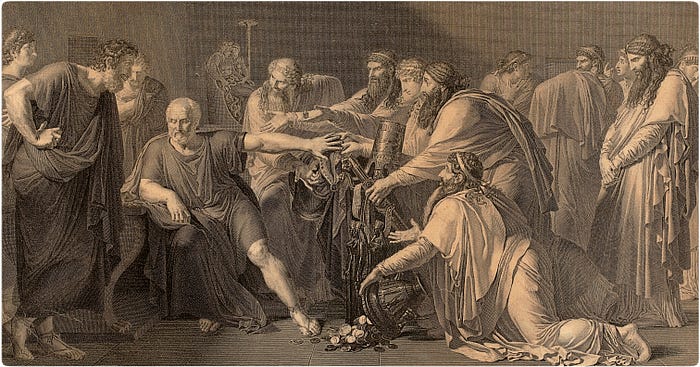
    The Decline and Fall of the Roman Empire, probably via use of the word "optics" ;) . I've been reading the Decline and Fall of the Roman Empire (abridged*, of course, at least to start with!). New to the topic, and I’ve never identified as a history buff, but I’m really loving it. I wanted to write a short post about it, but couldn’t quickly figure out how to say what I wanted briefly, so here’s a long one!

    It feels like a bird's-eye view of modern politics, in many ways, but especially regarding "The American Experiment." I'm sure this comparison isn't new--it's probably a huge part of what makes Decline and Fall popular today, despite being published in 1776. Since there's a whole trope about Rome buffs, I imagine many of you have hashed over all this a ton previously.

    The early part of Decline and Fall starts with how amazing Rome was. Of course, it built on other civilizations and governments that came before it, but I think we these days have a hard time imagining just how surprisingly modern it would seem to us, if we were transplanted to the Roman Empire in its heyday. Of course we have tons of hard tech they didn't. But on the social level, I think a lot of it would feel spookily familiar. (I’m sure the author and I are both missing or leaving out huge ways it’s different. But I think there’s still a lot we can learn from it.)

    Widespread assumption of and dedication to: rule of law, trial by peers, market-based economy. And somehow the start of the Roman Empire manifested a deep dedication among citizens and leaders to a Republic as the form of government. No nepotism, no monarchy, no might makes right. Government of the people, by the people, for the people, at least in spirit--my sense is people and government and military were all aligned in their dedication to that spirit. 

    And peace! Peace, for centuries, throughout a huge swath of the known world, where that hadn’t happened before. There was a kind of national religion they inherited from the Greeks, but they seem to have been even more dedicated to religious tolerance than to their religion (prior to Constantine and the Christians taking over). Sure, there was kind of constant fighting on the edges of the empire, including always against the pesky Gauls and German barbarians, who really hated the idea of being part of the big empire. But mostly, and especially compared to times before in much of Europe, you could live safe in your home with your family, for generations even, protected by law-abiding and law-enforcing local authorities, backed up by the Roman army when needed, truly answerable to the people through the representation of the Senate, such as it was, and it was pretty great as far as I can tell. 

    Now, the bird's-eye view of the modern USA comes in when, generation after generation, leader after leader, eventually monarch after monarch, the common-knowledge shared dedication to being a Republic and to all the ideas above, faded over time. First, one or two leaders came along who had enough sway over the army and enough popularity with the people that they were able to, against the grain of all Republic dedication, declare themselves effective leaders of the empire. First humbly, as first-among-many. Then with time, openly and pompously. Then with more time, it became obvious to everyone that the Republic was only a Republic in name, that it was just obviously "the way things worked" that the army effectively got to decide who became emperor, and that as soon as the army switched loyalties, you'd better be ready for a change, including probably a bunch of people getting killed for being on the wrong side. 

    The thing about Decline and Fall, wrt this kind of degradation, is you get to read real human stories of this happening, again, and again, and again, and again. The same patterns, the different humans with unique circumstances playing them out. 

    Why did the dedication to the original ideals degrade with time? I think the same natural processes, and lack of opposing processes, have led the US and myriad other democracies down similar paths over time. People and groups learn to subvert the system to get more of what they want in the short term, sacrificing the common-knowledge dedications and ideals that support the good things they have in the world. They pay less attention to the whole than is needed to maintain it. 

    I'll name what I see today as one instance of roughly this kind of degradation, and I hope it's a little spicy. I have been part of many, many conversations in organizations where, when discussing some strategic question for the organization, the word "optics" comes up. For the uninitiated, the word "optics" in this context means: people could see what we're doing and have interpretations of it. We don't want those interpretations to have bad consequences for us. So let's be sure to include in our strategizing some component of consideration for trying to get people's impressions (the public, journalists, stakeholders, or etc) to be at least neutral. I can understand that. But I want to live in a world where we're creating the whole we want, not mostly attempting to persuade or convince or if nothing else not be noticed by parts of society that IMO we ought to relate to as peers. If we all practice distrusting our peers' sense-making processes in this way of strategizing about "optics", we'll all end up with a society with worse and less sense-making. So what do I want instead? I want us to take actions with integrity. Yes to being aware of our reputation (individually, organizationally, etc) and acting with integrity.

    (*The abridged version I landed on, after some back and forth about versions with Claude, is the Womersly version. I love it. You get 100-200 pages of the above, which was just right for this first-timer.)

    #DeepTakes
    blakeSA•...
    Meta: I'm excited and nervous to post the first post on the schedule! Feels like butterflies before a soccer game when I was young. Feeling the uncertainty of what will arise here, what I'll learn....
    personal reflection
    blogging
    emotions
    Comments
    0
  • annabeth avatar

    Relateful Camp Connecting. This is thread is for things like:

    • Introducing yourself and meeting new people
    • Re-connecting with folks you know
    • Sharing how you're feeling about Relateful Camp
    • Human-ing together
    jordanSAin🏕️ Relateful Camp•...
    I'm so excited too, and I'm excited to see you again! I was so happy to get to know you last year, and be in each other's connection crew. It's a delight to know you as an individual, and to get to know more of annabeth —and therefore more of me and us!...
    interpersonal relationships
    personal reflection
    social interaction
    Comments
    0
  • J

    Better holding environments as a growth imperative. There is never just an individual.

    The word refers only to that side of the person who is differentiated from something.

    Something like relationships perhaps? Or maybe environments?

    My hot take is that relationships are environments in which individuals are embedded in - and at most levels these days, they pretty much suck. And that's why the world also has a lot of challenges right now. 

    I think it's imperative to our collective development that we have stronger holding environments.

    I think we can do quite much better in parenting, family life, schools, local communities, and global collaborations. I think we're ready for something more than personal development and interpersonal development. I wish for more group-development: groups learning how to support individual and group's development with, without and through being embedded in them. 

    I think it starts at the level of parenting and ends at the level of global coordination. 

    I'm greatly inspired by Robert Keagan's work around holding environment's role in human development. He talks about how "good" environments hold us (we are fused), let go of us (we differentiate), and stick around (we reintegrate back into). 

    I'm starting to come to terms that this is something that has my name on it. It's my life's work to create these kind of environments. This is why I'm so into parenting (the first holding environment), and community building (the art of holding holding environments). It's why I'm currently creating an alternative to a school. And building a village. I think uptrust is one example of this, and that's why I'm here.

    And I think Kegan is really on to something when he writes:

     “Your own sense of wholeness or lack of it is a large part a function of how your own current embeddedness culture is holding you.” 

    I'd love to dive deeper into more conversations about how we can make better environments. 

    nat•...

    I'm curious to learn more about what you're exploring Josephine. I don't know much or have anything much to say in response. But reading what you shared stirs something in me.

    communication
    personal reflection
    Comments
    0
  • jordan avatar

    What do you think about this short post? This is so short

    blakeSAin🍀 🍯 (clove and honey)•...

    Definitely lighter, feels pretty manageable nowadays! 

    mental health
    personal reflection
    Comments
    0
  • annabeth avatar

    What will the future literally look like? This idea comes from watching Mad Men- seeing smoking and drinking freely at the office for example, and my brother once pointing out that if a show or movie ever wanted to make it really clear that it was set in the 1990’s, all they’d have to do is have multiple people driving Saturn cars.

    So here are a few of what I think (hope) the future will literally look like:

    Gas stations will be very rare, and parking spaces will almost always have charging stations.

    Having a garage in homes will be rare because car ownership will be rare. Using self-driving Uber-esque systems will be way more affordable, and car ownership then will be similar to antique car ownership now.

    Lawns will be very rare, and permaculture-style of local fauna that doesn’t need care, upkeep, or watering will be common.

    What do you think the future will look like?

    jordanSA•...

    We did end up going and Stephanie loved it! And I really liked it :)

    personal reflection
    Comments
    0
  • B

    Schizophrenics on social media. I think that as emotions change it must be seen that at time when one felt angry at the world or sad. It came out on your posts on social media however when the good days come that can also come on social media so social media is a proof how at first how you thought with all the posts you were sending and then next when you feel better how do you talk and post then.

    If facebook is a place where people’s negativity is coming out. ok then when one is feeling more in control of ones emotions then a graduate gift could be to come into UPTrust. Where we are open to having dialogues where we can disagree in a peaceful manner yet try and understand where the other person is coming from. Instead of being boisterous or loud. We must accept others beliefs even if its different from our own and we still can be friends. You do what you want I do what I want yet we are together in harmony. Our friendship doesn’t end. But we must respect each other for the choices we are making as what feels right to us we will do even though others have their opinions. What I want for myself must be respected.

    dara_like_saraSAinreimagining social media with nithya shanti•...
    My family most often falls into that bucket. However, I usually have a much greater opportunity to see nuance with family. My relative who still staunchly refers to the Washington Commanders as the "Redskins" is the same one who would never miss a graduation, wedding, or funeral...
    family dynamics
    relationships
    personal reflection
    Comments
    0
  • brian avatar

    Led a Huachuma Circle yesterday for my birthday. Yesterday I had a 9-hour birthday party together with my friend K who is a plant medicine facilitator. This is our second foray into altered-states facilitation, and once again we proved correct the thesis that group trips and Relatefulness are a great combo.

    It’s hard to pin down what exactly the Huachuma was doing, but it led to a circle that was beautifully stably multi-threaded. There were 4 or 5 threads, and people were very confident staying in theirs, paying attention to the thing they were with, and the people they were with. At times there were multiple people crying, each in their own thing, each with other people attuning to them. The threads would recur as wanted, without anyone needing to direct the flow, channel to streams to be more rational, or more held.

    At one point K said We can have multiple threads at the same time, and I told him, I think you said that for yourself. They all already got it.

    jordanSA•...
    This is a beautiful share, thank you. I find your writing so personal and relatable at the same time. I have to try really hard to write like this; if i don’t it just comes out super theoretical. I’m afraid it comes across as arrogant as well, like I know better....
    conflict resolution
    social dynamics
    personal reflection
    writing style
    empathy
    Comments
    0
  • valerie@relateful.com avatar

    Who I Follow On the Internet and Why. My internet interest fall into three categories: Politics, NFL Football, Connection/Spirituality/Consciousness. I imagine lots of people follow to first two in combo and the combo of three might be a little unusual. ;)

    Politics: I follow the Bulwark which is a group of Republican insiders who have created a site with podcasts, articles, interviews with people who have broken with their former party lines over Trump’s running for President. They are smart, funny, unflinchingly honest (when Harris or Walz doesn’t perform well or do something not so good, they’re honest about it). They feel like centrists who have lost their party and I love them for it. Want them to start a new party. Largely Democratic sites are too biased…they paint everything on the donkey side with whitewash.

    NFL Football…Colin Cowherd is my guy. Again…fearless about saying when a team or a player has lost the plot. He’s smart, honest, has a larger perspective and has no sacred cows. Every week he holds a session called Where Colin was Right and where Colin was Wrong. I was delighted and surprised when he recently did a podcast about politics (out of the blue) and said he’s voting for Harris and why he sees it that way. His reasoning was so down to earth, factual, logical. The amazing part is that he was revealing this to his audience which is a sea of largely right wing NFL football fans. I loved him for it. Fiercely, unabashedly himself and not afraid of losing a part of his market because of his political views (I doubt he lost many…he’s that much better at football analysis than the rest).

    Consciousness wise, I like several people, Jordan being at the top. I also follow Hannah Taylor on substack. I find her interesting and sometimes surprising, though I don’t always agree.

    And I read stuff from Wall Street Journal, NY Times and random posts that show up because of who I follow. In my estimate, I spend more time online than I think is good. Would be good to look into why I do this, when it isn’t optimal according to me.

    jordanSA•...
    Thanks for sharing this Val. I hadn’t heard of the Bulwark until you mentioned them the other day and it’s really good to know they exist! I’m excited to share them with Republican / conservative-esque friends....
    personal reflection
    politics
    media
    Comments
    0
  • dara_like_sara avatar

    Dynamic between Walz and Vance. So far, I am genuinely surprised at how respectful they seem to be toward each other.

    Vance has said things like I’m sure Walz agrees with me and our democratic friends

    The energy is really good for me.

    jordanSA•...

    amen, I was basically heartened by this whole debate!

    religion
    personal reflection
    debate
    Comments
    0
Loading related tags...